

Walk into any stone showroom, browse any interior design website, and you will almost certainly encounter two names side by side: quartzite and quartz. They sound almost identical, they can look strikingly similar, and they are both touted as excellent countertop and cladding materials. Yet they are fundamentally different products — one born deep in the earth over millions of years, the other engineered in a factory from crushed minerals and polymer resins. Choosing the wrong one for your project can mean unexpected maintenance, premature damage, or simple dissatisfaction with how the surface performs.
This comprehensive guide cuts through the confusion. Written by the stone specialists at Vietcan Stone, it explains exactly what quartzite and quartz are, how they are formed or manufactured, how they compare across every important performance category, and how to make the right choice for your specific application. Whether you are renovating a family kitchen, designing a luxury bathroom, or specifying stone for a commercial project, the information below will give you the confidence to decide with certainty.
Expert insight from Vietcan Stone: The single most common mistake buyers make is assuming quartzite and quartz are the same thing because they share a similar name. Understanding the distinction can save you thousands in maintenance costs over the life of your surface.
What Is Quartzite? The Born-in-the-Earth Stone

Formation & Geological Origin
Quartzite is a naturally occurring metamorphic rock. It begins its life as sandstone — sedimentary rock composed primarily of sand-sized quartz grains. Over millions of years, intense heat and pressure deep within the Earth’s crust cause the sand grains to fuse and recrystallize without melting, transforming the sandstone into quartzite. This process, known as metamorphism, creates an extremely dense, hard material with interlocking quartz crystals that make it one of the most durable natural stones available.
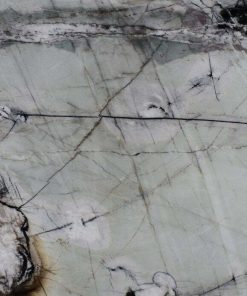
The result is a stone that is predominantly silicon dioxide (SiO2) — the same mineral as pure quartz — but arranged in a distinctly crystalline matrix that gives quartzite its characteristic sparkle, depth, and often dramatic veining. Because no two pieces of stone experience identical geological conditions, every quartzite slab is genuinely unique.
Visual Characteristics
Quartzite is frequently compared to marble in appearance because many varieties display flowing veins and a soft luminous quality. However, quartzite is significantly harder and more resistant to acid etching than marble. Common color ranges include white, light grey, cream, beige, gold, pink, and green, depending on the mineral impurities present during formation. Some of the most sought-after quartzite varieties — such as Super White, Sea Pearl, and Taj Mahal — are prized precisely because their appearance mimics high-end marble while offering superior durability.
The surface texture of a polished quartzite slab has an almost translucent depth that is very difficult to replicate with engineered products. Designers often choose quartzite for statement pieces, feature walls, and high-visibility countertops where visual drama is as important as performance.
Key Properties of Quartzite
- Hardness: 7 or above on the Mohs scale (harder than most natural stones, including most marbles)
- Heat resistance: Naturally tolerates high temperatures — ideal for kitchen surfaces near cooktops
- UV resistance: Does not fade or degrade in sunlight, making it suitable for outdoor applications
- Porosity: Moderately porous — requires periodic sealing to prevent staining
- Uniqueness: Every slab is one-of-a-kind, offering unmatched natural beauty
Quartzite
Quartzite
Quartzite
Quartzite
Quartzite
Quartzite
Quartzite
Quartzite
Quartzite
Quartzite
Quartzite
Quartzite 




What Is Quartz (Engineered Stone)? The Manufactured Marvel

Manufacturing Process
Quartz countertops — often called engineered quartz or simply quartz — are a man-made product. Despite the name, they are not a natural stone. They are manufactured by combining approximately 90–95% crushed natural quartz mineral with 5–10% polymer resins, pigments, and other additives. The mixture is compacted under vacuum and vibration, then cured under heat to form a hard, uniform slab.
The manufacturing process gives producers precise control over color, pattern, and thickness. Brands like Caesarstone, Silestone, Cambria, and Cosentino have built entire product lines around consistent, reproducible designs that range from pure white to dramatic veined patterns that closely mimic natural stone.
Visual Characteristics
Because engineered quartz is manufactured, its appearance is highly consistent across slabs. This is a significant advantage for large projects where matching slabs across multiple surfaces is important. Pigments and printing technology have advanced to the point where modern quartz slabs can replicate the look of marble, concrete, and even quartzite with remarkable accuracy — though a trained eye or direct comparison will often reveal the difference.
The trade-off is that quartz lacks the organic depth and uniqueness of natural stone. Patterns in engineered quartz can repeat across a slab, and the surface — while attractive — tends to have a slightly more uniform, manufactured quality.
Key Properties of Engineered Quartz
- Non-porous surface: Resists staining without any sealing — a major practical advantage
- Hardness: Around 7 on the Mohs scale — comparable to quartzite but dependent on resin content
- Consistency: Uniform color and pattern across production runs — ideal for large installations
- Low maintenance: Requires only regular cleaning with mild soap and water
- Heat sensitivity: Polymer resin binders can yellow, crack, or scorch under sustained high heat
- UV sensitivity: Prolonged sunlight exposure causes discoloration — not suitable for outdoor use
Quartz
Quartz
Quartz
Quartz
Quartz
Quartz
Quartz
Quartz
Quartz
Quartz
Quartz
Quartz 


Quartzite vs Quartz: Side-by-Side Comparison
The table below summarizes the key differences between quartzite and engineered quartz across the most important performance and practical categories:
| Feature | Quartzite | Quartz (Engineered) |
| Origin | Natural metamorphic rock | Engineered (95% quartz + resin) |
| Hardness (Mohs) | 7+ (very hard) | ~7 (hard) |
| Heat Resistance | Excellent (withstands heat) | Moderate (resin may yellow) |
| Scratch Resistance | Very high | High |
| Stain Resistance | Needs sealing periodically | Excellent (non-porous) |
| Maintenance | Seal every 1–3 years | Very low — wipe clean |
| Appearance | Unique veining; one-of-a-kind | Consistent, uniform patterns |
| UV / Outdoor Use | Excellent | Not recommended (resin fades) |
| Price Range | $60–$200+ per sq ft | $50–$150 per sq ft |
| Best For | Kitchens, outdoor, high-end design | Kitchens, bathrooms, busy families |
See More: Top 15 Most Beautiful Stone Countertops for 2026 Granite, Marble, Quartz & Quartzite
Durability: Which Stone Will Last Longer?
Both quartzite and quartz are among the most durable countertop materials available — far tougher than most wood, laminate, or tile options. However, they excel in different conditions.
Scratch Resistance
Quartzite, with a Mohs hardness of 7 or above, is slightly harder than many engineered quartz products. It can withstand direct contact with most metal utensils and everyday kitchen tools. Quartz is also highly scratch-resistant, but its hardness varies depending on the resin content used by the manufacturer — higher resin content can slightly reduce hardness.
Heat Resistance
This is where quartzite holds a clear advantage. As a natural rock formed by heat and pressure, quartzite can tolerate direct contact with hot pots and pans without damage. The polymer resin in engineered quartz, however, can discolor, crack, or lose its bond with the underlying minerals under sustained high heat. Most quartz manufacturers recommend always using trivets or hot pads.
Vietcan Stone recommends: If you regularly cook with high heat and tend to set hot cookware directly on the countertop, quartzite is the safer choice for your kitchen.
Impact Resistance
Both materials are susceptible to chipping at corners and edges from sharp impacts, though neither is particularly prone to cracking under normal use. Quartzite is generally considered slightly more brittle than quartz due to its crystalline structure, while quartz’s resin binder provides a degree of flexibility that can absorb impact energy.
Maintenance & Care: Day-to-Day Practicality
Quartzite Maintenance
The most important maintenance task for quartzite is periodic sealing. Because quartzite is a porous natural stone, liquids — particularly acidic substances like wine, coffee, citrus juice, and cooking oils — can penetrate the surface and cause staining if not sealed. A quality impregnating sealer fills the microscopic pores in the stone and creates a temporary barrier against liquid penetration.
Depending on the density of the specific quartzite and the level of use, resealing is typically recommended every one to three years. The process is straightforward and can be done by a homeowner in under an hour, but it is an ongoing commitment. Beyond sealing, quartzite should be cleaned with pH-neutral stone cleaners and wiped promptly after spills.
Quartz Maintenance
Engineered quartz is one of the lowest-maintenance countertop materials on the market. Its non-porous surface means it does not require sealing — ever. Stains sit on the surface rather than penetrating it, and most can be removed with a damp cloth and mild dish soap. Harsh chemicals, abrasive scrubbers, and bleach-based cleaners should be avoided as they can dull the surface finish over time, but everyday cleaning could not be simpler.
For busy families, households with young children, or commercial environments where countertops take heavy daily abuse, quartz’s near-zero maintenance requirement is a compelling argument in its favor.
See More: Quartz vs. Marble: Which Belongs in Your Kitchen?
Aesthetics: Natural Beauty vs. Designed Perfection
The Case for Quartzite’s Natural Beauty
There is something irreplaceable about natural stone. The veining in quartzite is formed by mineral deposits following ancient fracture lines in the rock — no two slabs will ever be identical. Light interacts differently with the crystalline surface depending on the angle and intensity of illumination, creating a living quality that changes throughout the day. For clients who value authenticity, organic beauty, and a connection to the natural world, quartzite delivers an aesthetic experience that no engineered product can fully replicate.
High-end quartzite varieties like Taj Mahal, Calacatta Gold Quartzite, and Macaubus White have become design icons in luxury residential and hospitality projects around the world, appearing on the covers of architectural magazines and in award-winning kitchen and bathroom designs.
The Case for Quartz’s Consistent Elegance
Engineered quartz offers something that natural stone cannot: absolute predictability. When you select a quartz slab, you know exactly how the finished surface will look. Large islands, extended countertop runs, matched backsplashes, and multiple bathroom vanities can all be specified in the same color and pattern with confidence that every piece will look identical.
Modern manufacturing technology has dramatically improved the realism of quartz designs. Premium engineered quartz products from leading manufacturers now feature large-format veining, subtle tonal variation, and surface textures that can be genuinely difficult to distinguish from natural stone in photographs or casual observation. For clients who love the marble look but want the peace of mind that comes with a non-porous surface, quartz is an outstanding solution.
Best Applications: Where Each Material Shines
Where Quartzite Excels
- Kitchen countertops (especially near cooktops and ranges)
- Outdoor kitchens, BBQ surrounds, and exterior cladding
- Feature walls and statement design elements
- High-end residential kitchens and master bathrooms
- Hospitality and luxury commercial projects
- Fireplace surrounds and hearth applications
Where Quartz Excels
- Family kitchens with heavy daily use
- Bathrooms (main and en-suite)
- Office kitchenettes and commercial break rooms
- Rental properties and investment units requiring low maintenance
- Projects requiring consistent color-matching across many surfaces
- Clients who prefer to avoid periodic sealing
See More: How to Choose a Kitchen Countertop Stone: 5 Key Factors Every Homeowner Should Know
Cost Comparison: Budgeting for Your Project
Both quartzite and quartz represent a mid-to-high investment compared to materials like ceramic tile or laminate, but they deliver a far superior finished result. Here is a general guide to pricing:
Quartzite Pricing
Entry-level quartzite (more common, less dramatic veining) typically starts around $60–$80 per square foot installed. Mid-range quartzite with attractive veining and color variation generally falls in the $80–$130 range. Rare and highly sought-after varieties such as Taj Mahal or Sea Pearl can reach $150–$200 or more per square foot installed. The natural rarity of these stones, transportation costs, and the skill required for fabrication all contribute to pricing.
Quartz Pricing
Standard engineered quartz typically starts around $50–$75 per square foot installed. Premium quartz with realistic stone-look designs from leading international brands generally falls between $80–$130 per square foot. Ultra-premium quartz with large-format veining or exclusive designs can reach $130–$150+ per square foot. While the base material may sometimes cost less than comparable quartzite, installation and fabrication costs are broadly similar.
Total Cost of Ownership
When calculating the true cost of your countertop investment over 10–20 years, factor in quartzite’s periodic sealing requirement (approximately $30–$50 in materials per application, or $150–$300 if professionally done every few years) against quartz’s maintenance-free advantage. In most scenarios, the long-term cost difference is modest, and the choice should be driven primarily by performance requirements and aesthetic preference.
How to Choose: A Decision Framework
With all the information above in hand, here is a straightforward decision framework to guide your choice:
Choose Quartzite If…
- You value authenticity and the unique beauty of natural stone
- Your application involves high heat (kitchen near cooktop, outdoor kitchen)
- The surface will be exposed to sunlight or outdoor conditions
- You are designing a high-end, luxury, or statement-piece application
- You appreciate organic variation and are willing to commit to periodic sealing
Choose Quartz If…
- Low maintenance is a top priority (young children, busy household, commercial use)
- You need consistent color and pattern across a large or multi-piece installation
- The surface will primarily be used in a bathroom or indoor setting away from high heat
- You love the look of marble or natural stone but prefer a non-porous surface
- Your budget is firm and you want predictable pricing with no ongoing maintenance costs
Vietcan Stone expert tip: The best choice is always the one that fits your lifestyle, not just your aesthetic preference. A beautiful quartzite that develops stains because you have a busy family is never as satisfying as a quartz surface that looks pristine after years of daily use — even if the quartzite is technically the more ‘premium’ material.
See More: Kitchen Countertop Trends in Canada: A Complete, Practical Design Guide
Frequently Asked Questions
Is quartzite harder than quartz?
Generally yes — natural quartzite typically registers 7 or above on the Mohs hardness scale, while engineered quartz usually falls around 7, depending on the resin content. However, the practical difference in everyday scratch resistance is minimal for most users.
Does quartz stain more easily than quartzite?
No — quartz is actually more stain-resistant than unsealed quartzite because its non-porous surface prevents liquids from penetrating. Quartzite’s stain resistance is excellent when properly sealed, but it requires that sealing to be maintained over time.
Can quartzite be used outdoors?
Yes. Quartzite’s UV stability and heat resistance make it an excellent choice for outdoor kitchens, patios, pool surrounds, and exterior cladding. Engineered quartz is not recommended for outdoor applications because its polymer resin binders are sensitive to UV radiation and will discolor over time.
How do I tell quartzite and quartz apart in a showroom?
Look at the slab closely. Natural quartzite will have organic, irregular veining with subtle variation in crystal size and mineral distribution. You may see small sparkling crystals when light hits the surface at certain angles. Engineered quartz will typically have a more uniform appearance — even when it mimics stone veining, the pattern often has a slight regularity or repetition that the trained eye can detect. When in doubt, ask your supplier for the material’s technical data sheet.
Which material adds more resale value to a home?
Both high-quality quartzite and premium engineered quartz are considered desirable upgrades that can positively influence property value. In luxury markets, natural quartzite — particularly prestigious varieties — may carry a slight premium perception. In mainstream and family-oriented markets, quartz’s maintenance-free reputation often resonates strongly with buyers.
Conclusion
Quartzite and quartz are both exceptional materials that deserve their popularity in contemporary architecture and interior design. Quartzite offers the irreplaceable beauty and performance of natural stone — unmatched heat resistance, outdoor durability, and a unique aesthetic that no manufactured product can truly replicate. Quartz offers the practical advantages of modern engineering — a non-porous, maintenance-free surface with consistent appearance and excellent durability.
The right choice depends entirely on your specific application, lifestyle, maintenance preferences, and aesthetic vision. The information in this guide gives you everything you need to make that decision with confidence. And when you are ready to take the next step — whether that means browsing slabs, requesting samples, or speaking with one of our stone specialists — Vietcan Stone is here to help.