
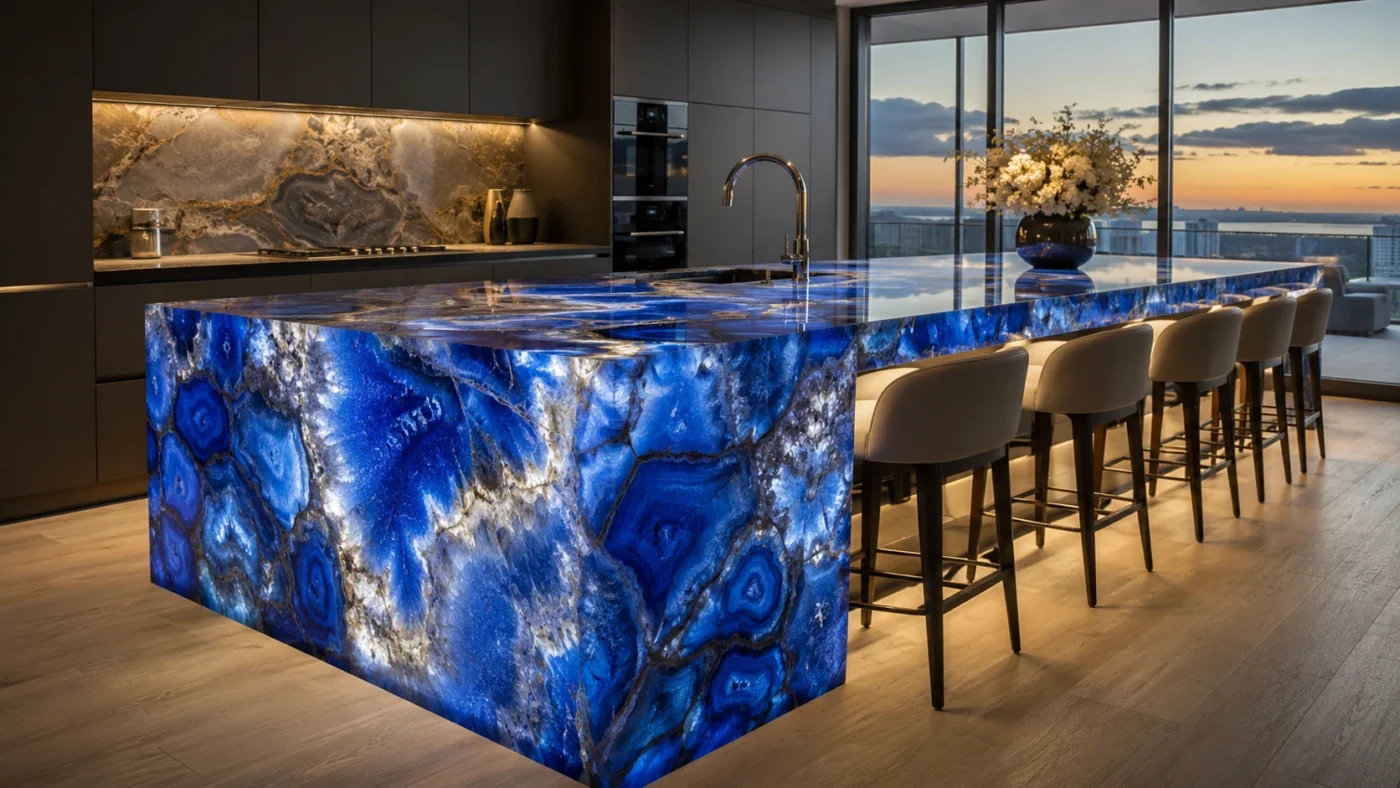
Homeowners across Canada are searching for ways to turn ordinary kitchens and bathrooms into spaces that feel personal, artistic, and undeniably luxurious. One material choice stands above the rest for sheer visual impact: semi-precious and backlit stone countertops. These surfaces combine the natural beauty of rare minerals with the drama of internal lighting, creating a glowing centerpiece that no quartz or granite slab can replicate.
In this guide, we explain what semi-precious and backlit stone countertops are, why they are becoming a signature feature in Canadian homes, how they are made, what they cost, and how to choose a fabricator you can trust for a project this ambitious. Whether you are renovating a kitchen island, designing a home bar, or planning a spa-style bathroom, this article will help you understand the material before you invest in it.
What Are Semi-Precious and Backlit Stone Countertops
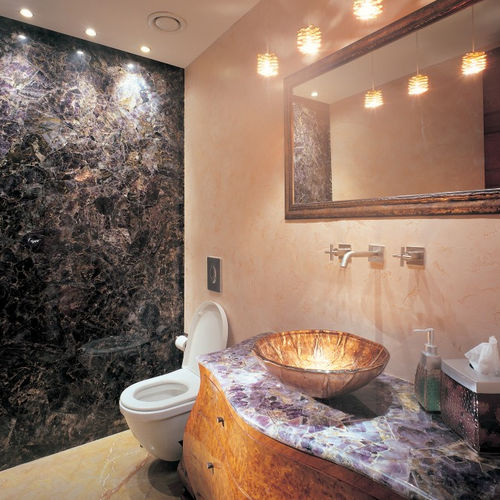
Semi-precious stone countertops are surfaces cut from natural or engineered slabs containing minerals such as agate, quartz crystal, amethyst, jasper, or onyx. Unlike standard granite or marble, these materials often have a degree of translucency, meaning light can pass through thin sections of the stone. That translucency is what makes backlighting possible.
A backlit countertop is built with an LED lighting layer installed beneath a thin slice of translucent stone, usually mounted on a reinforced glass or resin backing for strength. When the lights are switched on, the natural veining, crystal formations, and color bands within the stone appear to glow from within. The effect transforms a simple work surface into a functional piece of art, and it is one of the most requested features in high-end interior design today.
Why Canadian Homeowners Are Choosing Backlit Stone
Canada’s design market has shifted noticeably toward personalized, statement-making interiors rather than uniform, catalogue-style finishes. Backlit stone countertops fit that shift for several reasons.
- They create a focal point that instantly elevates an open-concept kitchen or entertainment bar.
- They work exceptionally well in Canada’s long winter evenings, when a warm glowing surface adds ambiance to a home.
- Each slab is unique, so no two installations look identical, which appeals to homeowners who want a one-of-a-kind result.
- They photograph beautifully, which matters for homeowners who plan to list a property or share their renovation online.
- They pair well with both modern minimalist interiors and warmer, natural-material aesthetics that are currently popular in Canadian design.
For custom home builders, boutique hotels, and high-end restaurants across Canada, backlit stone has also become a way to differentiate a space and create a memorable guest experience.
Popular Semi-Precious Stones for Countertops
Not every mineral is suitable for a countertop, since the material must be able to be cut into slabs, reinforced, and used safely in a home environment. The most common choices include:
- Agate: Known for its banded, wave-like patterns and strong translucency, agate is one of the most popular choices for backlit kitchen islands and bar tops.
- Amethyst and crystal quartz: These offer deep purple or clear crystalline texture and are often used as accent panels rather than full countertops due to cost and slab size limits.
- Onyx: A calcite-based stone with soft, flowing veining that glows warmly under light, frequently chosen for bathroom vanities and feature walls.
- Petrified wood and jasper: These bring an organic, earthy pattern and are often used for rustic-luxury interiors.
- Engineered semi-precious composites: For larger surfaces or tighter budgets, fabricators can combine crushed semi-precious stone with resin to create larger, more consistent slabs while retaining a similar glow effect.
Semi-Precious
Semi-Precious
Semi-Precious
Semi-Precious
Semi-Precious
Semi-Precious
Semi-Precious
Semi-Precious
Semi-Precious 


How Backlighting Technology Works
Building a backlit countertop is a precision process that requires the right combination of material thickness, lighting, and structural support.
- Slab thinning: The natural stone is cut down to a thin panel, typically between 8 and 20 millimeters, to allow enough light transmission without compromising strength.
- Reinforcement: A resin or glass backing panel is bonded to the stone to add durability, since thin natural stone alone is fragile.
- LED layer: A flat LED panel or strip lighting system is installed behind the stone, often on a dimmer or smart control so homeowners can adjust brightness and mood.
- Sealing and edge work: The finished piece is sealed to protect against moisture and stains, then edge-profiled to match the rest of the kitchen or bathroom design.
Because this process combines stonework, electrical installation, and structural engineering, it should always be handled by a fabricator with specific experience in illuminated stone, not a general countertop installer.
Where to Use Semi-Precious and Backlit Stone in a Canadian Home
While kitchen islands are the most common application, backlit stone is increasingly used throughout the home.
- Kitchen islands and waterfall countertop edges, where the glow becomes the centerpiece of the room.
- Home bars and wine rooms, where the lighting adds a lounge-like atmosphere.
- Bathroom vanities and shower feature walls, particularly with onyx for a spa-like effect.
- Reception desks and feature walls in boutique offices, hotels, and restaurants.
- Dining tables and console tops as smaller, more budget-friendly accent pieces.
Cost Considerations for Backlit Stone Countertops in Canada
Backlit and semi-precious stone countertops sit at the premium end of the countertop market. Pricing depends on the type of stone, slab size, lighting complexity, and installation requirements. Compared to standard granite or quartz, expect a significant premium because of the specialized cutting, reinforcement, and electrical work involved.
For Canadian homeowners planning a renovation budget, it is worth requesting a detailed quote that separates material cost, lighting system cost, structural support, and installation labor. This transparency helps avoid surprises and allows for realistic comparison between fabricators. Working with a supplier who sources and fabricates the stone directly, rather than through multiple resellers, can also help control cost while maintaining quality.
Durability and Maintenance
Semi-precious stone countertops require a bit more care than standard granite, but with proper sealing and reasonable use, they are built to last for many years.
- Reseal the surface periodically as recommended by your fabricator to maintain stain resistance.
- Avoid placing extremely hot cookware directly on the surface; use trivets to protect both the stone and the lighting layer beneath it.
- Clean with a pH-neutral stone cleaner rather than harsh acidic or abrasive products.
- Have the LED components inspected occasionally, since the lighting system is the one element that differs from a standard stone countertop.
When properly installed by an experienced fabricator, the reinforced backing significantly reduces the risk of cracking that can occur with unsupported thin stone.
Choosing a Trustworthy Fabricator
Because backlit stone countertops combine specialized stone cutting with electrical work, the fabricator you choose matters more than with a standard countertop project. Canadian homeowners and designers should look for a few key signals of expertise and reliability.
- A portfolio of completed backlit and semi-precious stone projects, not just standard granite or quartz work.
- Clear communication about slab sourcing, since natural semi-precious stone availability varies and affects both cost and timeline.
- In-house fabrication capability, which usually results in better quality control than outsourced cutting.
- Transparent quoting that separates material, lighting, and installation costs.
- A warranty or guarantee covering both the stonework and the lighting components.
These factors matter for expertise, authority, and trust: the three qualities homeowners should evaluate before committing to a statement piece that will anchor their kitchen or bathroom for years to come.
Design Trends to Watch
Interior designers working across Canada are increasingly pairing backlit stone with matte black fixtures, warm wood cabinetry, and integrated smart lighting controls. Waterfall edges that wrap a glowing panel down the side of an island remain one of the most requested design details, along with dual-tone islands that combine a backlit accent strip with a more traditional quartz or granite work surface for everyday practicality.
As smart home technology becomes standard in new builds, expect backlit stone to be increasingly paired with app-controlled dimming and color temperature adjustment, allowing homeowners to shift the mood of a kitchen from bright task lighting to a soft evening glow with a single tap.
Sourcing and Sustainability
As demand for semi-precious stone grows, sourcing has become an important part of the conversation for Canadian buyers who care about the origin and ethics of their materials. Reputable fabricators should be able to explain where their slabs come from, whether the stone is natural or an engineered composite, and how offcuts and waste material are managed during fabrication.
Engineered semi-precious composites, which blend crushed natural stone with resin binders, offer a more consistent supply and can reduce waste compared to relying solely on large natural slabs, which are limited in size and availability. Asking a supplier directly about their sourcing practices is a reasonable and increasingly common question, and a transparent answer is a good sign of a fabricator you can trust with a long-term investment like a countertop.
Comparing Backlit Stone to Other Premium Surfaces
Homeowners weighing a backlit stone countertop against other premium options, such as book-matched marble, large-format porcelain, or exotic granite, should consider what each material actually delivers. Book-matched marble offers dramatic veining but no illumination. Porcelain slabs are extremely durable and low maintenance but cannot replicate the internal glow of translucent stone. Exotic granite provides unique patterning at a lower cost than semi-precious stone but again lacks the light-transmitting quality that makes backlit installations so distinctive.
In short, if the goal is maximum durability at the lowest cost, standard quartz or granite remains the practical choice. If the goal is a genuinely unique, artistic centerpiece that cannot be replicated by any other surface on the market, semi-precious backlit stone is very difficult to match.
Bring the Glow of Natural Stone Into Your Home
Semi-precious and backlit stone countertops represent one of the most striking design choices available to Canadian homeowners today. The combination of natural mineral beauty and warm internal lighting creates a result that feels personal, artistic, and genuinely rare. As with any premium material, the outcome depends heavily on the craftsmanship behind it, from slab selection to structural reinforcement to the quality of the lighting integration.
See more:
Top 15 Most Beautiful Stone Countertops for 2026 Granite, Marble, Quartz & Quartzite