
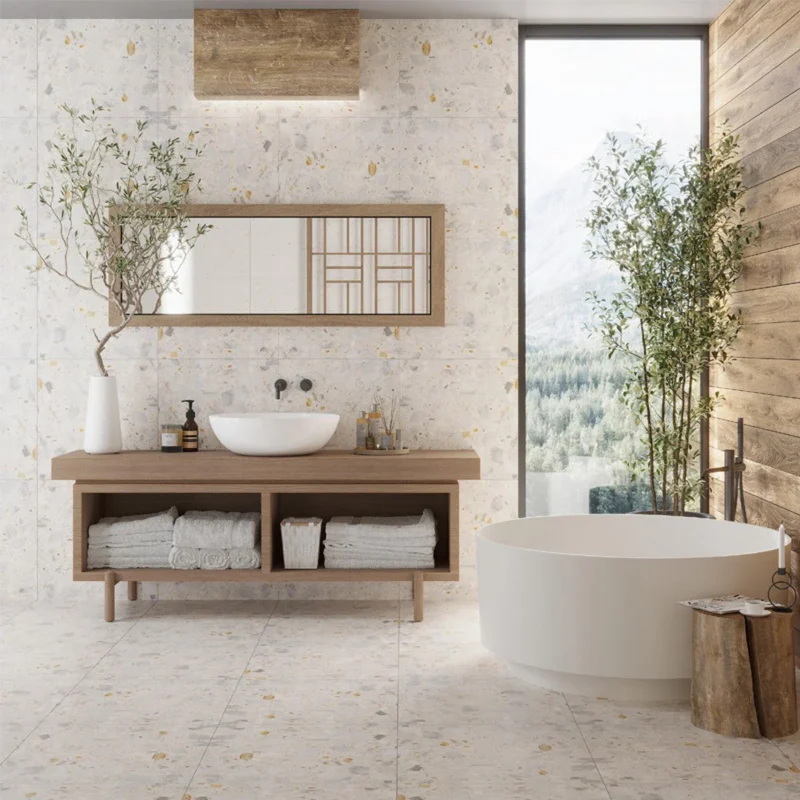
There is a reason luxury hotels, award-winning spas, and high-end residential projects continue to choose natural stone for their bathrooms decade after decade. No manufactured surface can fully replicate the depth, warmth, and singular beauty that emerges when light moves across a polished marble wall or a textured quartzite floor. Each slab is a one-of-a-kind piece of the earth, formed over millions of years and finished to reveal patterns that no factory can reproduce.
At Vietcan Stone, we have spent years sourcing, cutting, and supplying premium natural stone to architects, interior designers, and discerning homeowners across the region. This guide draws on that hands-on expertise to walk you through everything you need to know about using natural stone in bathrooms — from the best stone types for wall cladding to the smartest choices for wet-room floors, plus design ideas that will inspire your next project.
1. The Case for Natural Stone in Bathroom Design
1.1 Timeless Aesthetic Appeal
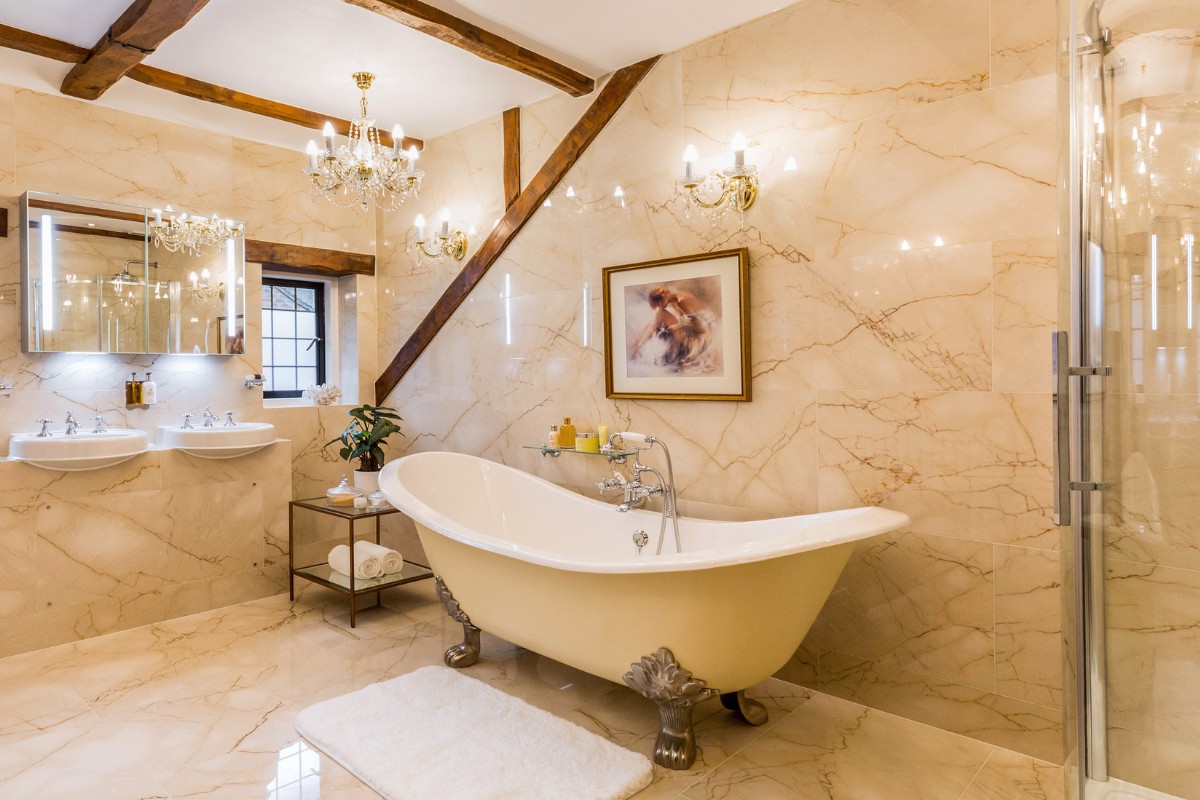
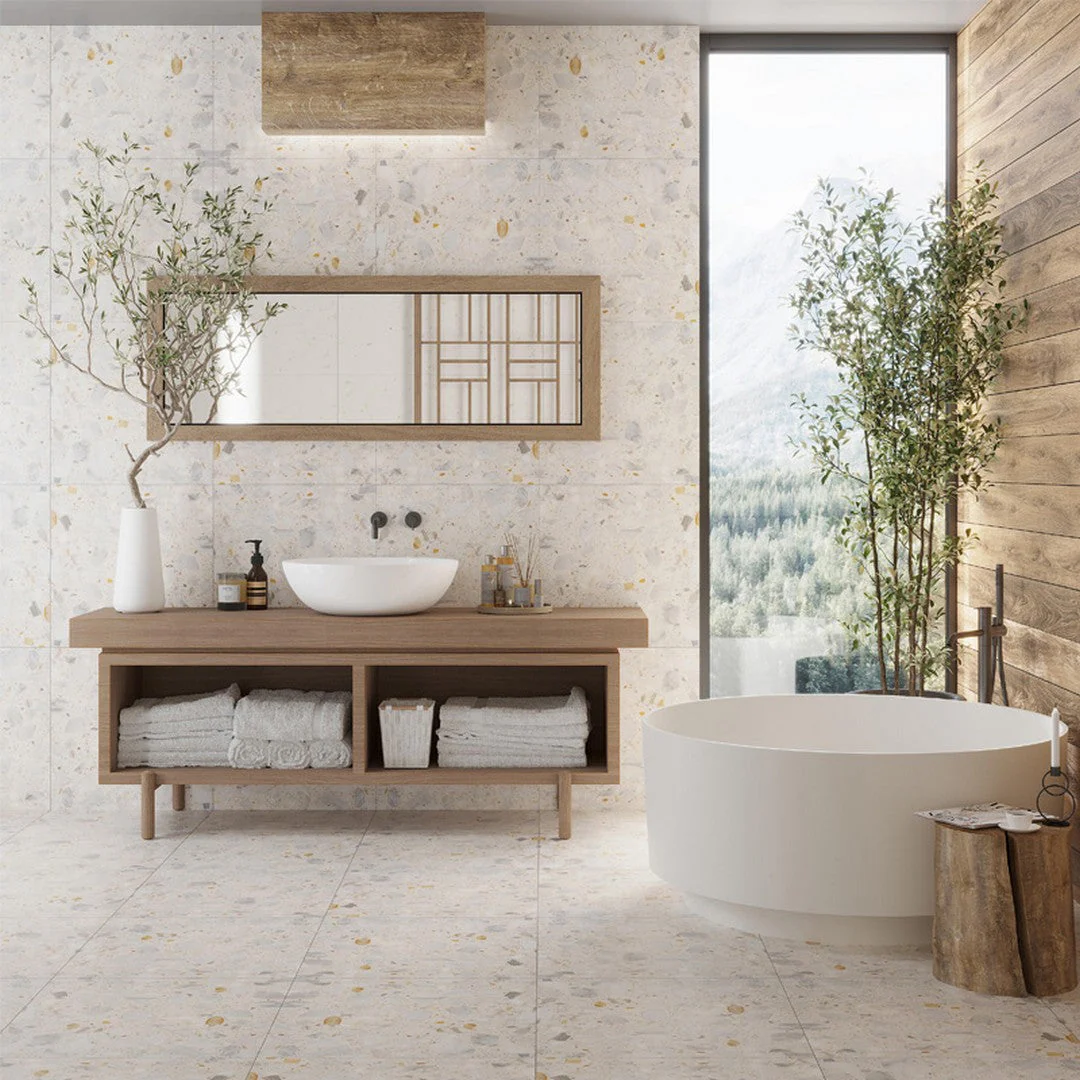
Unlike porcelain tiles or synthetic surfaces that follow trend cycles, natural stone carries an inherent elegance that transcends fashion. A Calacatta marble bathroom installed today will look just as sophisticated in 30 years. The veining, mineral inclusions, and tonal variations create visual depth that photographs beautifully and feels even more impressive in person.
Interior designers frequently cite natural stone as a “forever material” — one that justifies its higher upfront cost through longevity, timelessness, and the perception of quality it instantly communicates to anyone who enters the space.
1.2 Durability and Longevity
When properly sealed and maintained, natural stone surfaces in bathrooms can last the lifetime of the building. Granite countertops and floors, for example, resist scratches and heat far better than engineered composites. Quartzite — often confused with quartz — is one of the hardest natural stones available, making it an outstanding choice for high-traffic bathroom floors that need to withstand years of wet foot traffic without showing wear.
1.3 Health and Indoor Air Quality
Unlike vinyl, laminate, or some synthetic tiles that may off-gas volatile organic compounds (VOCs), natural stone is inherently non-toxic. For homeowners concerned about indoor air quality — especially in steam showers or enclosed bathroom spaces — stone is one of the cleanest choices available. It is also naturally cool to the touch, which many people find refreshing in humid bathroom environments.
1.4 Investment Value
Real estate professionals consistently report that natural stone finishes — particularly in master bathrooms — increase resale value and accelerate time on market. Buyers associate stone with quality construction and luxury living, making it a sound design investment beyond its aesthetic merits.
2. The Best Natural Stone Types for Bathrooms
2.1 Marble – The Classic of Luxury Bathrooms
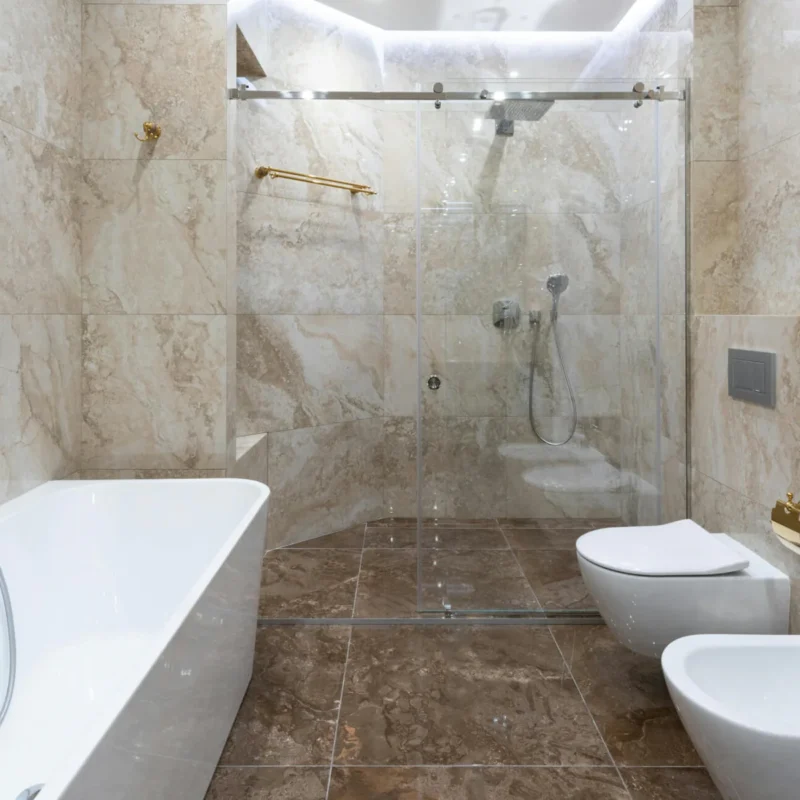
Marble has been synonymous with luxury bathrooms since antiquity. Its crystalline structure allows light to penetrate slightly below the surface, creating a luminous, three-dimensional quality no other material can match. The characteristic veining — caused by mineral impurities folded into the limestone during metamorphism — means every slab tells a different geological story.
Best applications in bathrooms:
- Feature walls and full-height wall cladding in master suites
- Vanity tops and sink surrounds
- Freestanding bath surrounds and platforms
- Floor tiles in lower-traffic areas (honed finish for slip resistance)
Popular marble varieties for bathrooms include Carrara (classic white-grey Italian marble), Calacatta (bold white with dramatic gold or grey veining), Statuario (bright white with fine dark veining), and Emperador (rich brown with cream veining).
Care note: Marble is calcium carbonate, making it sensitive to acidic substances like citrus cleaners, vinegar, and some shampoos. Regular sealing every 1–2 years and pH-neutral cleaning products are essential to maintaining its beauty long-term.
2.2 Granite – The Workhorse of Natural Stone
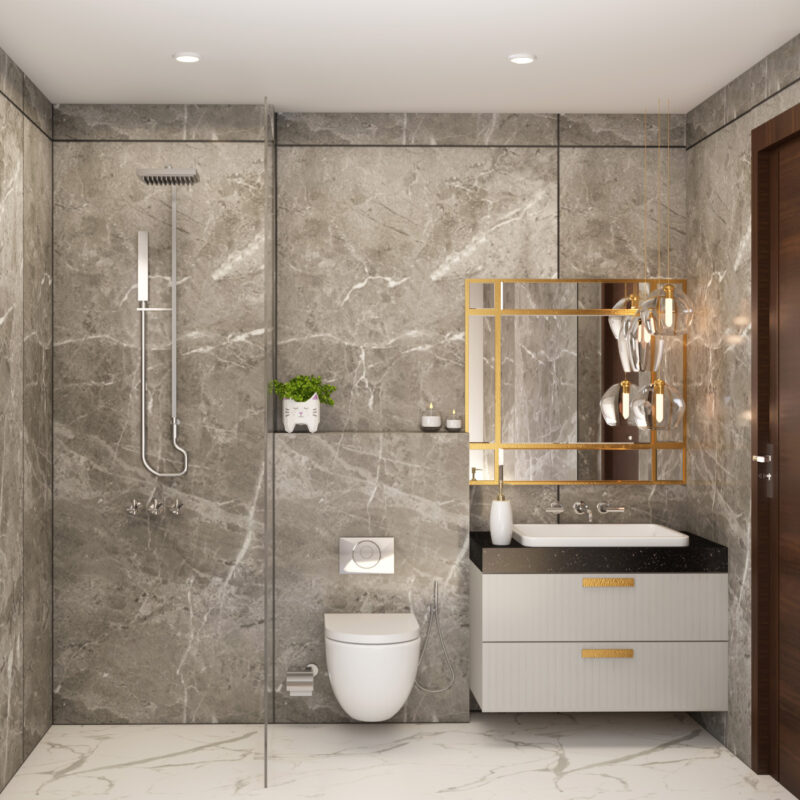
Granite is an igneous rock formed from slowly cooled magma, which gives it an exceptionally dense, crystalline structure. In practical terms, this means granite is highly resistant to scratching, staining, and moisture absorption — all critical qualities in a bathroom environment.
Best applications in bathrooms:
- Bathroom floors, including wet rooms and walk-in showers
- Vanity and countertop surfaces
- Shower walls and surrounds
- Exterior-facing bathroom surfaces
Granite comes in an enormous range of colours and patterns, from classic speckled black-and-white to dramatic blues, greens, and reds. Its naturally non-porous surface (once sealed) makes it one of the most hygienic stone options for wet areas.
2.3 Quartzite – The Rising Star of Bathroom Design
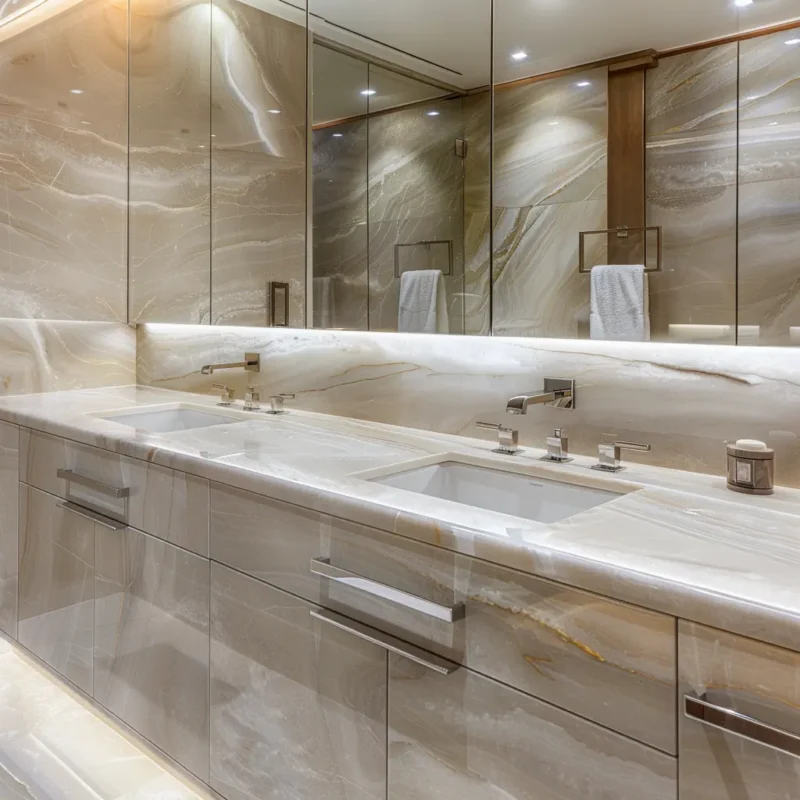
Quartzite is a metamorphic rock formed when sandstone is subjected to extreme heat and pressure, transforming the sand grains into interlocking quartz crystals. The result is one of the hardest, most durable natural stones available — harder than granite — while retaining the elegant, veined appearance that many homeowners love about marble.
Best applications in bathrooms:
- High-traffic bathroom floors and shower trays
- Wet room cladding
- Vanity tops in family bathrooms with heavy daily use
- Outdoor showers and pool bathrooms
Quartzite is often available in soft whites, warm creams, and dramatic greys with bold veining, making it visually appealing as well as exceptionally hardwearing. It requires sealing but is generally more forgiving than marble in daily use.
2.4 Onyx – The Dramatic Statement Stone
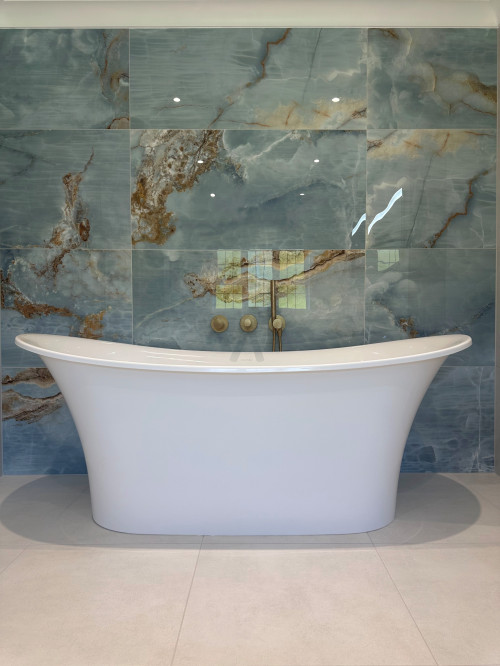
Onyx is perhaps the most theatrical of all bathroom stones. Formed from the slow deposition of calcite in cave environments, onyx is translucent — meaning that when backlit, it glows with an otherworldly luminosity that stops people in their tracks. Banded in rich golds, deep greens, blacks, and dramatic reds, onyx turns any bathroom surface into a work of art.
Best applications in bathrooms:
- Backlit feature panels and shower walls
- Vanity fronts with LED underlighting
- Luxury spa accent walls
- Small decorative panels and inserts
Onyx is softer and more fragile than other stones and requires careful installation and maintenance. However, for statement applications where drama is the goal, nothing rivals its impact.
2.5 Semi-Precious Stones – Ultra-Luxury Finishes
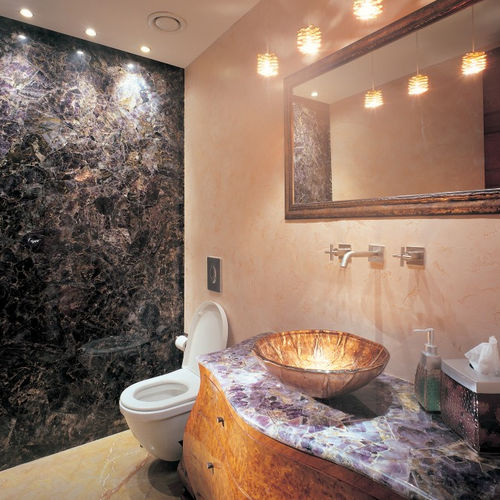
For the most exceptional residential and hospitality projects, semi-precious stones such as amethyst, agate, malachite, and tiger’s eye can be used as bathroom wall panels, vanity tops, or decorative features. These materials are typically sliced thin and backlit to reveal their extraordinary colour and mineral structure. The result is a bathroom that functions as a gallery installation as much as a functional space.
2.6 Porcelain and Natural Stone: Understanding the Difference
While high-quality porcelain tiles now convincingly mimic the appearance of natural stone, there remain fundamental differences that matter to discerning buyers. Natural stone has genuine depth, variation, and tactile character that porcelain cannot replicate. Each natural stone tile is unique; porcelain uses repeating digital prints. For clients who want the real thing — with all its complexity and authenticity — natural stone is irreplaceable.
3. Bathroom Wall Cladding with Natural Stone
3.1 Full-Height Wall Cladding: Maximum Impact
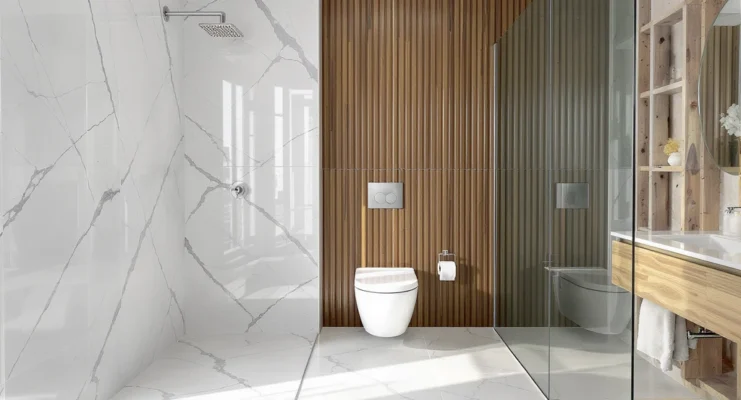
One of the most powerful ways to use natural stone in a bathroom is as full-height wall cladding — running the stone from floor to ceiling without interruption. This approach creates a sense of enclosure and warmth, wrapping the space in natural beauty. It works especially well in shower enclosures, where the continuous surface also eliminates grout joints that can harbour mould and discolour over time.
For full-height cladding, large-format slabs (120×240cm or larger) are increasingly popular, as they minimise joins and create the dramatic, seamless appearance of a luxury hotel spa. Vietcan Stone supplies book-matched slabs for this application — pairs of slabs cut from the same block and opened like a book, so the veining mirrors perfectly across the wall.
3.2 Feature Walls: Targeted Luxury
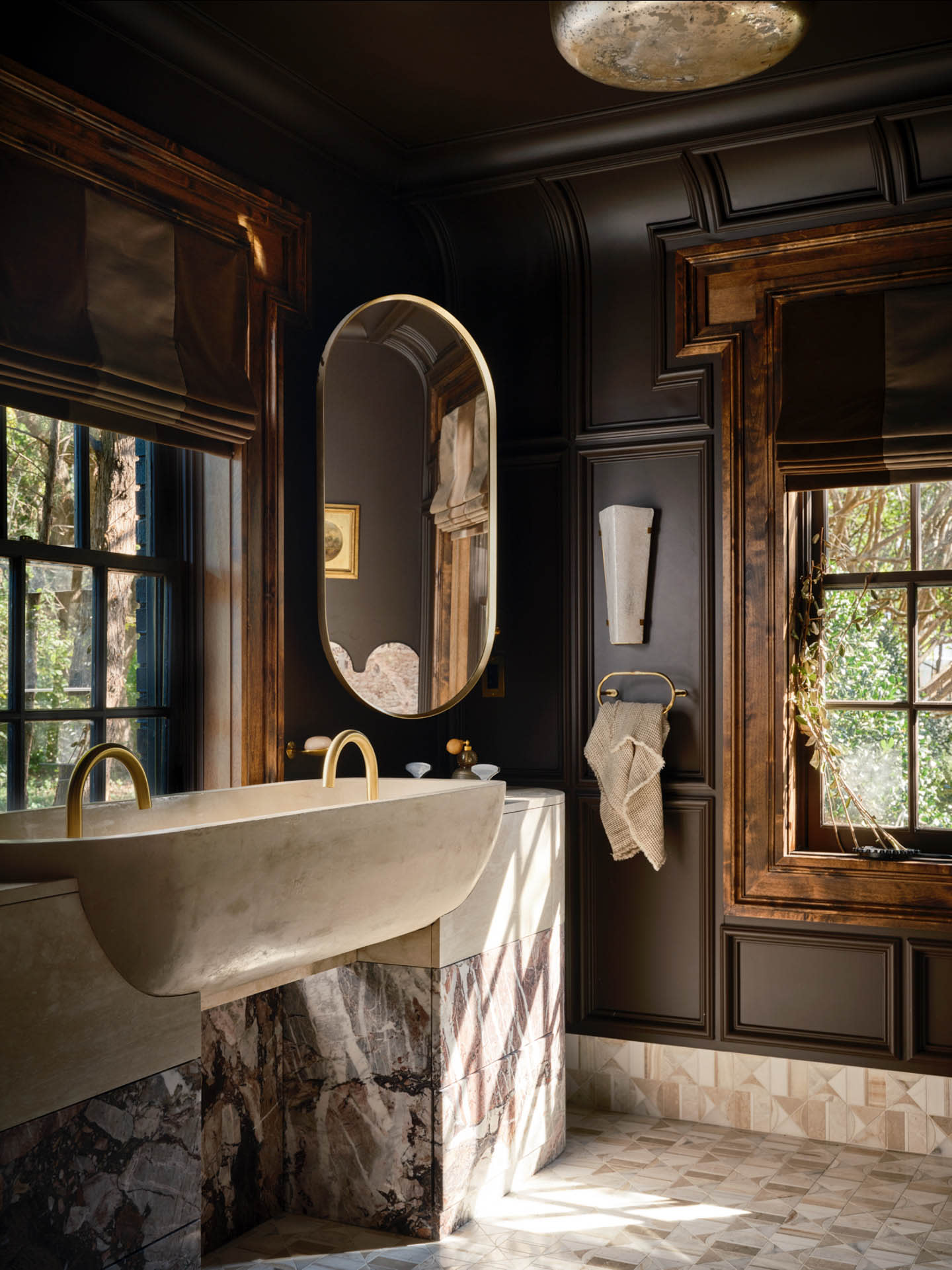
If a full cladding project is beyond budget, a single feature wall in natural stone delivers exceptional impact for a lower investment. The wall behind a freestanding bathtub is the most popular choice — creating an immediate focal point visible from the doorway. A stone-clad niche in the shower for toiletries, or a dramatic stone wall behind twin vanities, can anchor the design without cladding the entire room.
3.3 Stone Mosaic and Decorative Insets
Natural stone mosaics — small tiles in marble, onyx, or granite assembled into sheets — offer a way to introduce texture, pattern, and colour into a bathroom design. They work beautifully as shower floor inserts, border details, or decorative bands within larger tile schemes. Because the individual tesserae are small, mosaics conform easily to curved surfaces and can be used in niches, alcoves, and curved walls.
3.4 Waterproofing and Installation Considerations
Natural stone wall cladding in wet areas requires careful installation by experienced stonemasons. Key considerations include:
- A fully waterproofed substrate beneath the stone — typically a tanked cement board or approved waterproofing membrane
- Appropriate adhesive rated for natural stone and wet areas — standard tile adhesives can cause efflorescence (white mineral staining) on porous stones
- Correct grout selection — epoxy grout is recommended in shower areas for its resistance to mould and staining
- Sealing all stone surfaces before grouting and again after, to close the stone’s pores and prevent moisture ingress
The Vietcan Stone technical team can advise on the correct specification for any bathroom cladding project, including substrate preparation, adhesive selection, and sealing products matched to your specific stone type.
See More: Top 15 Most Beautiful Stone Countertops for 2026 Granite, Marble, Quartz & Quartzite
4. Natural Stone Floor Tiles for Bathrooms
4.1 Slip Resistance: The Critical Factor
Safety is the primary consideration when selecting natural stone floor tiles for wet bathroom areas. The slip resistance of a stone floor is determined by its surface finish and texture. Key finishes and their suitability for wet areas include:
- Honed (matte): Smooth but not polished. Good slip resistance, widely used in bathrooms. Shows fewer watermarks than polished.
- Brushed / Antique: Surface slightly textured by wire brushing. Excellent grip, natural aged appearance.
- Sandblasted: More aggressively textured. Very high slip resistance for wet rooms and outdoor showers.
- Flamed: Surface rippled by extreme heat. Excellent grip. Used in outdoor bathrooms and pool areas.
- Polished: Mirror-like finish. Beautiful but slippery when wet — avoid in shower floors and wet rooms.
4.2 Floor Tile Sizing and Layout
The size and layout of natural stone floor tiles significantly affects the perceived scale and character of a bathroom. Large-format tiles (60×60cm, 80×80cm, or 120×60cm) create a sense of spaciousness and minimise grout joints, making them ideal for contemporary bathrooms. Smaller tiles and mosaics — particularly in shower trays — provide more grout lines, which actually improves grip underfoot and also helps the floor drain effectively when laid with a slight fall.
Classic formats like the 30×30cm or 40×40cm square remain popular for their versatility and ease of installation, while running bond (brick) and herringbone patterns add visual interest to marble and limestone floors.
4.3 Underfloor Heating Compatibility
Natural stone is an excellent conductor of heat, making it ideal for use with underfloor heating systems. Stone floors warm up efficiently and retain heat well, keeping bathroom floors comfortable underfoot even in cooler months. When installing underfloor heating beneath natural stone, ensure the system is appropriate for your stone thickness and that adequate expansion joints are incorporated to accommodate thermal movement.
4.4 Maintenance of Stone Bathroom Floors
A properly sealed and maintained natural stone bathroom floor is surprisingly easy to care for in everyday use. General guidance:
- Seal the stone before use and reseal every 1–2 years depending on foot traffic and stone porosity
- Clean regularly with a pH-neutral stone cleaner — avoid acidic or bleach-based products on marble and limestone
- Address spills promptly; even sealed stone can stain if acidic substances are left to sit
- Use a soft mop or microfibre cloth for daily cleaning — avoid abrasive scrubbing pads
- For polished floors, a professional re-polish every few years restores the surface brilliance
See More: Quartz vs. Marble: Which Belongs in Your Kitchen?
5. Design Inspiration: Natural Stone Bathroom Styles
5.1 The Modern Minimalist Spa
Characterised by large-format stone slabs, minimal grout joints, concealed hardware, and a restrained palette of two or three stone tones. Think floor-to-ceiling grey quartzite in the shower, a white marble vanity top, and a polished concrete floor in the transition zone. Clean lines, neutral tones, and an absence of visual clutter create a space that feels like a private wellness retreat.
5.2 The Classic Marble Bathroom
Nothing signals luxury quite like an all-marble bathroom. Calacatta or Carrara marble on the walls and floors, paired with polished nickel fixtures and a freestanding white soaking tub, creates a timeless interior that feels equally at home in a historic townhouse or a contemporary penthouse. Book-matched marble slabs on opposing walls create a symmetrical, gallery-like effect that is breathtaking in scale.
5.3 The Earthy, Organic Retreat
Warm stones — golden travertine, sandy quartzite, rich brown onyx — combined with natural wood accents, rattan, and organic textiles create a bathroom that feels deeply connected to the natural world. Rough-textured stone walls contrast with smooth stone floors, and the colour palette draws from the earth: terracotta, ochre, walnut, and cream.
5.4 The Dramatic Dark Bathroom
Black granite, deep green marble, or dark quartzite make a powerful statement in a bathroom designed around drama and sophistication. Paired with matte black fixtures, low ambient lighting, and warm accent lighting to illuminate the stone’s mineral depth, a dark stone bathroom feels like a refuge — intimate, luxurious, and utterly distinctive.
5.5 The Hotel-Inspired Master Ensuite
Five-star hotels have long set the benchmark for bathroom design. The signature elements — a large walk-in rain shower with full stone cladding, a freestanding soaking tub positioned to frame a view or a feature wall, twin floating vanities with stone tops, and generous use of a single stone species throughout — translate beautifully into residential master ensuites. Continuity is key: using the same stone across floors, walls, and surfaces creates the seamless, immersive quality that defines the luxury hotel aesthetic.
| ✦ EXPLORE THE VIETCAN STONE NATURAL STONE COLLECTION
Vietcan Stone offers an exceptional range of natural stone for bathroom projects — from classic white Carrara marble to dramatic black granite, luminous quartzite, and rare semi-precious panels. Our collection is curated for architects, interior designers, and homeowners who demand the very best. Browse our Natural Stone Collection today and discover your perfect material. |
6. Choosing the Right Stone for Your Bathroom: A Decision Framework
6.1 Consider Your Usage Pattern
A master ensuite used by two adults has very different requirements from a family bathroom used by children or a commercial spa receiving hundreds of guests per week. High-traffic areas should prioritise durability and easy maintenance — granite and quartzite excel here. Lower-traffic luxury bathrooms can accommodate more delicate choices like marble and onyx.
6.2 Consider Your Climate
In humid tropical climates, choose stones with lower porosity or ensure rigorous sealing schedules. Granite and quartzite are naturally more resistant to moisture than marble and limestone. In cooler climates where underfloor heating is used, check your stone’s thermal compatibility and specify appropriate expansion joints.
6.3 Consider Your Light Conditions
Dark stones like nero marquina marble or black granite absorb light and work best in bathrooms with ample natural light or well-designed artificial lighting. Lighter stones — white marble, cream travertine, pale quartzite — reflect light and brighten darker bathrooms. Backlit onyx panels can introduce drama and warmth to bathrooms that lack natural light.
6.4 Consider Your Design Language
The stone should complement your broader interior design language. Heavily veined marble suits bold, statement-led interiors. Uniform granite complements contemporary minimalism. Textured quartzite sits comfortably in organic, biophilic designs. Semi-precious stones are best reserved for ultra-luxury projects where the material itself is the art.
See More: Kitchen Countertop Trends in Canada: A Complete, Practical Design Guide
7. Professional Installation: Why It Matters
Even the most beautiful natural stone will underperform if poorly installed. The specific gravity and weight of natural stone slabs — particularly large-format pieces — require reinforced substrates and specialist adhesives. In wet areas, the waterproofing layer beneath the stone is as important as the stone itself; a failure here will eventually cause the stone to lift, crack, or show mineral staining on its surface.
Vietcan Stone works with a network of experienced natural stone installers who understand the specific requirements of different stone types, bathroom environments, and installation formats. We also provide full technical support — from substrate specification to adhesive selection to grout recommendation — ensuring that the stone we supply performs exactly as intended for the life of the building.
8. Expert Tips from the Vietcan Stone Design Team
- Always specify your bathroom dimensions and usage pattern when requesting stone recommendations — the right stone for a master ensuite may be very different from the right stone for a spa wet room.
- Request physical samples before committing to a specification. Stone photographs differently under different light conditions; always view samples in situ if possible.
- Consider the veining direction when laying large-format marble. Vertical veining on walls tends to draw the eye upward and adds height; horizontal veining creates breadth.
- Book-match your slabs for feature walls and shower enclosures. This involves cutting adjacent slabs from the same block and opening them like a book, so the veining mirrors perfectly — an effect that dramatically elevates the perceived luxury of the installation.
- Plan your stone layout on paper before cutting. Large-format slabs are beautiful but unforgiving — poor planning can result in awkward cuts, wasted material, and disrupted veining at corners and edges.
- Invest in professional sealing at installation and maintain a resealing schedule appropriate to your stone type and usage. This single maintenance step protects your investment and ensures decades of beauty.
- If budget is a constraint, prioritise stone on the feature wall and shower enclosure — the highest-impact areas — and use a coordinating engineered surface (Vantage Quartz or LQ Color) for the remaining surfaces. This maximises visual impact while managing cost.
Conclusion: Invest in Natural Stone, Invest in Timeless Beauty
Natural stone for bathrooms is more than a design choice — it is an investment in quality, longevity, and the kind of beauty that only the natural world can produce. Whether you are drawn to the classical elegance of marble, the industrial strength of granite, the modern drama of quartzite, or the otherworldly luminosity of onyx, there is a natural stone that will transform your bathroom into something genuinely extraordinary.
At Vietcan Stone, we are proud to be the trusted source of premium natural stone for architects, interior designers, and homeowners who refuse to compromise on quality. Our team brings deep material knowledge, technical expertise, and a passion for stone that shows in every project we support.
We invite you to explore the Vietcan Stone Natural Stone Collection and discover the perfect material for your bathroom project. From first enquiry to final installation, we are here to help you create a space that will be admired for generations.
| ✦ READY TO TRANSFORM YOUR BATHROOM? TALK TO VIETCAN STONE.
Contact the Vietcan Stone team today for expert stone selection advice, technical specification support, sample lending, and project consultation. Explore our Natural Stone Collection, Vantage Quartz, CiQ Colors, LQ Color, Printed Quartz, and Clearance Collections — all available through Vietcan Stone showrooms and our project team. Your dream bathroom begins with the right stone. It begins with Vietcan Stone. |
Natural stone
Natural stone
Natural stone
Natural stone
Natural stone
Natural stone
Natural stone
Natural stone
Natural stone
Natural stone 


